Manohar Lal Reviews NHPC Projects in J&K, Says IWT Put in Abeyance Over Terrorism
Total Views |


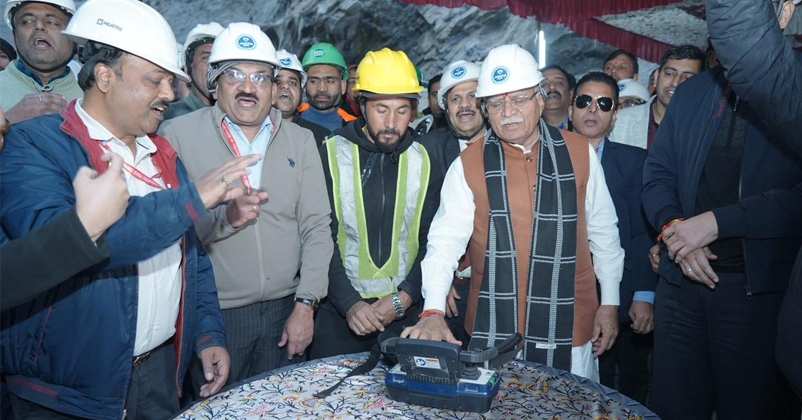
Union Minister of Power and Housing & Urban Affairs, Shri Manohar Lal Khattar, arrived in Jammu on Sunday to review NHPC’s hydroelectric projects in the Union Territory of Jammu and Kashmir. He was accompanied by Shri Pankaj Agarwal, Secretary (Power), Ministry of Power.
During the visit, NHPC CMD Bhupendra Gupta briefed the Minister about the progress of various hydroelectric projects in J&K. The Minister’s two-day visit includes inspections in Reasi, Ramban, and Kishtwar districts.
Shri Manohar Lal visited NHPC’s Salal Power Project in Reasi district, where he reviewed the ongoing works. He instructed NHPC officials to speed up sediment removal from the Salal reservoir.
It is pertinent to mention that the Salal Power Station, located on the Chenab River in Reasi district, is undertaking sediment removal works following the termination of the Indus Waters Treaty (IWT), aimed at removing accumulated silt and maximizing optimal utilization of water resources.
During his visit, the Minister also planted saplings inside the Salal Power Station premises, highlighting the government’s focus on environment protection and sustainable development. He also met local administration and senior officials to ensure better coordination for timely completion of projects.
While travelling to Kishtwar, the Minister carried out an aerial inspection of the 1856 MW Sawalkot Hydroelectric Project. In Kishtwar, he visited the Ratle Hydroelectric Project, where he laid the foundation stone for dam concreting works and urged the team to complete the project within the set timeline.
Speaking on Pakistan’s remarks, Manohar Lal Khattar said that Pakistan’s statements have no value. He stated that Prime Minister Narendra Modi placed the Indus Waters Treaty in abeyance because Pakistan has continuously encouraged terrorism.
India decided to place the Indus Waters Treaty (IWT) in abeyance because Pakistan has repeatedly supported and encouraged cross-border terrorism, despite enjoying the benefits of the treaty for decades. Under the 1960 agreement, India showed restraint and goodwill, even during wars and hostile relations.
Due to the treaty, India suffered major losses in water usage rights. India was not allowed to fully use the waters of the western rivers; Indus, Jhelum and Chenab, which flow through Indian territory before entering Pakistan. These rivers were largely reserved for Pakistan, while India was allowed only limited, non-consumptive use such as run-of-the-river hydropower, without large storage or diversion.
As a result, India could not build adequate dams, reservoirs or irrigation projects on these rivers, leading to loss of water storage capacity, electricity generation, irrigation potential and flood control in Jammu & Kashmir. Meanwhile, Pakistan continued to benefit from uninterrupted water flow while sponsoring terror activities against India.