The Success Story of Vaccination Drive in Kashmir Valley
23 Sep 2021 20:52:00
- Vivekanand Nartam
India has given befitting reply to its naysayers and detractors in the global media such as CNN in relation to its world's largest vaccination drive against Covid-19. India had set a target of administering 60 crore doses by the end of August this year. By Monday (August 30) morning, India had already administered over 63 crore doses, total vaccination doses being 82, 65, 15,754 as on 22 September.2021. "That adds up to a total of 600 million shots, and Modi's government wants to complete the whole process by August. That's an incredibly ambitious undertaking, especially for a developing country with poor rural infrastructure and an inadequate public health system that is already buckling under tremendous pressure from the coronavirus," CNN had written.
The country has given at least one dose to more than 62 per cent of its eligible population. It has also further boosted its vaccine production capacity by adding more vaccine candidates such as Zydus Cadila. Emergency use approvals given to vaccine candidates such as Covishield, Covaxin, Sputnik, and Moderna and Jonson and Jonson has sufficiently poised the country for any challenge that might arise in the future. While developed countries such as United States are still struggling to cope up the Covid situation, states such as Florida being the case, India has been making rapid progress on this count.
Initially, though, India witnessed the snail’s pace of vaccination in some parts of the country owing to hesitancy and lack of vaccination doses, it soon overcame such hurdles. Credit must be given to Indian health administration and its committed health workers. Even the sensitive regions like Kashmir Valley played significant role in contributing to the success story of India’s vaccination plans. Therefore it’s also important to acknowledge the positive role played by Valley’s people and the committed administration in the region.
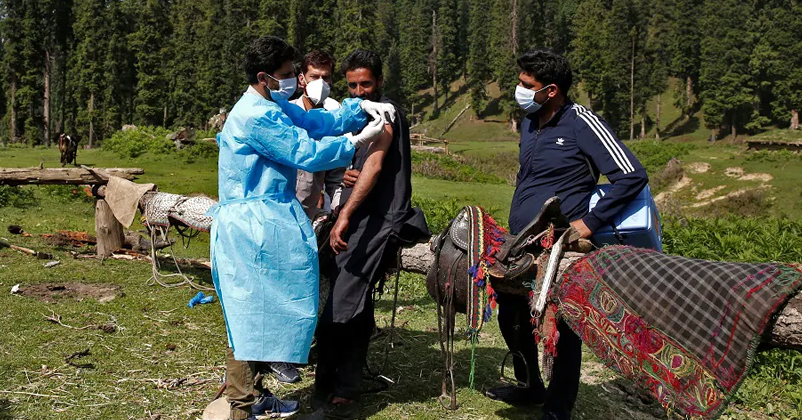
Initiatives in Kashmir such as the ‘night doorstep vaccination’ drive launched by the healthcare administration have proven a boon. This strategy, particularly, was adopted in some remote villages of Kudara, Chandaji, and Sumla of Bandipora district, as the villagers usually go out to graze their cattle during the daytime and return back only in the evening. The health workers of the district chose to vaccinate these people in the time slots of 7-11 pm so that the people don’t miss their jabs.
Kashmir Valley did fall short of vaccines in the initial days of May recording zero vaccines for a day. There was also initial hesitancy among people surrounding vaccines. But due to innovative action plans and strategies adopted by the valley’s healthcare administration raised the bar high. Presently, the vaccination rate in Kashmir in the age group of above 45 years has gone up to 70 percent, which is more than the national average. A remote village called Weyan, in the Bandipora district became the first in the country to achieve a 100 percent adult vaccination rate on 9 June 2021.
In other parts of Jammu and Kashmir territory, the “J&K Model” involved influencers such as religious leaders and local elders who helped administration in dispelling vaccine hesitancy among people. The administration also sought help of Police and media for crowed management and awareness generation as part of its micro planning and execution. The “Vaccine on Wheels” campaign helped the administration in reaching out to people in the far flung areas. These well planned and astutely managed strategies have yielded good results vaccinating 100% people with the first dose.
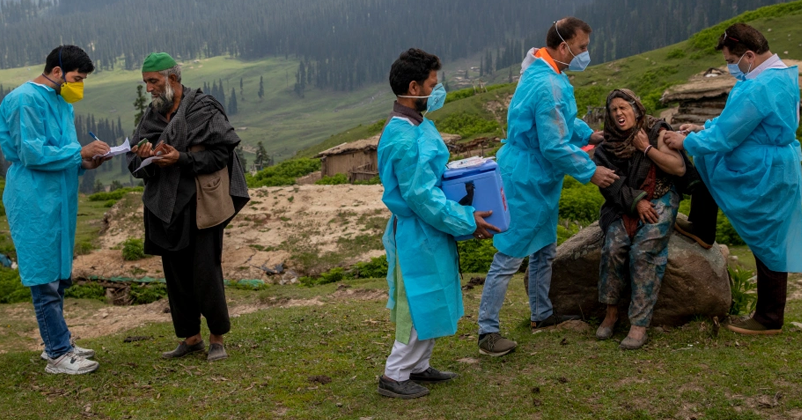
Vaccination drives carried out in the districts like Shopan, Ganderbal and Pulwama that are known for their difficult terrain is worth mentioning. This feat could be achieved only because of the relentless efforts and hard work put in by the healthcare teams. Similarly, the health workers in the two blocks of Uri and Boniyar falling close to Line of Control (LoC) in North Kashmir have walked several kilometers and vaccinated people living in the mountains. Most of these places have poor internet facility or no internet at all.
Credit for the effective execution of plans intended to tackle Covid must also be given to political dispensation of the Union Territory of Jammu and Kashmir. It’s because of their willingness that the provisions enshrined in the 73rd and 74th amendments of Indian constitutions could be implemented. The synergy between funds, functions and functionaries empowered local bodies giving them autonomy to take necessary steps in time bound manner.
Another thing that the administration deserves appreciation for is that it took timely steps to raise oxygen generation capacity of the region. For example, J&K presently generates 60,000 LPM of Oxygen which it earlier produced merely 14,000 LPM. As per some of the reports in the electronic and the print media, there was sufficient oxygen in all government hospitals even during the peak of the second wave of Covid. No patient was refused treatment due to lack of oxygen in the government aided hospitals.
These developments augur well with people of Jammu and Kashmir and nation as a whole. As the central and regional government of J&K gear up for the overall development of the valley, healthy and forward looking people will become means of that change. The Heaven on Earth will then reclaim its glory again making itself the most sought after place for tourists, investors and businessmen across globe.
(Vivekanand Nartam is an Assistant Professor of Political Science at Shyam Lal College, University of Delhi.)